Toasted Couscous Rice Pilaf

1/2 cup pearl couscous

1 scallion, finely chopped

3 tbsp olive oil

1/4 of a yellow onion, finely chopped

2 cloves of garlic, finely chopped

1/2″ knob of ginger, peeled and finely chopped

3 cups long grain rice, rinsed 3 times

2.5 cups water

1.5 cup full-fat unsweetened coconut milk

2 tsp hondashi stock powder (can be omitted if vegetarian)

2 tbsp butter

1.5 tsp salt

1 tsp white pepper

Equipment: Sauté pan with lid, slotted spoon, heatproof bowl, chef knife

  1. Put the olive oil in the pot and turn your burner to medium. Once the oil is loose and shimmering, add the couscous and toast until golden brown.
  2. Remove the couscous to your heatproof bowl, leaving as much oil in the pot as possible. Turn the heat to medium-low and add your scallion, onion, garlic and ginger. Cook until softened, but not browned.
  3. Add the rest of your ingredients, stir well and bring to a boil over medium-high heat.
  4. Once fully boiling, stir one more time and scrape any sticking rice off of the bottom to prevent clumping and burning. Turn the heat to as low as possible and cover with the lid. Simmer for 15 minutes.
  5. Remove the pot from the heat and let it sit covered for 15 more minutes. After the time has elapsed, fluff the rice with your slotted spoon until all the grains are separated as much as possible and serve!
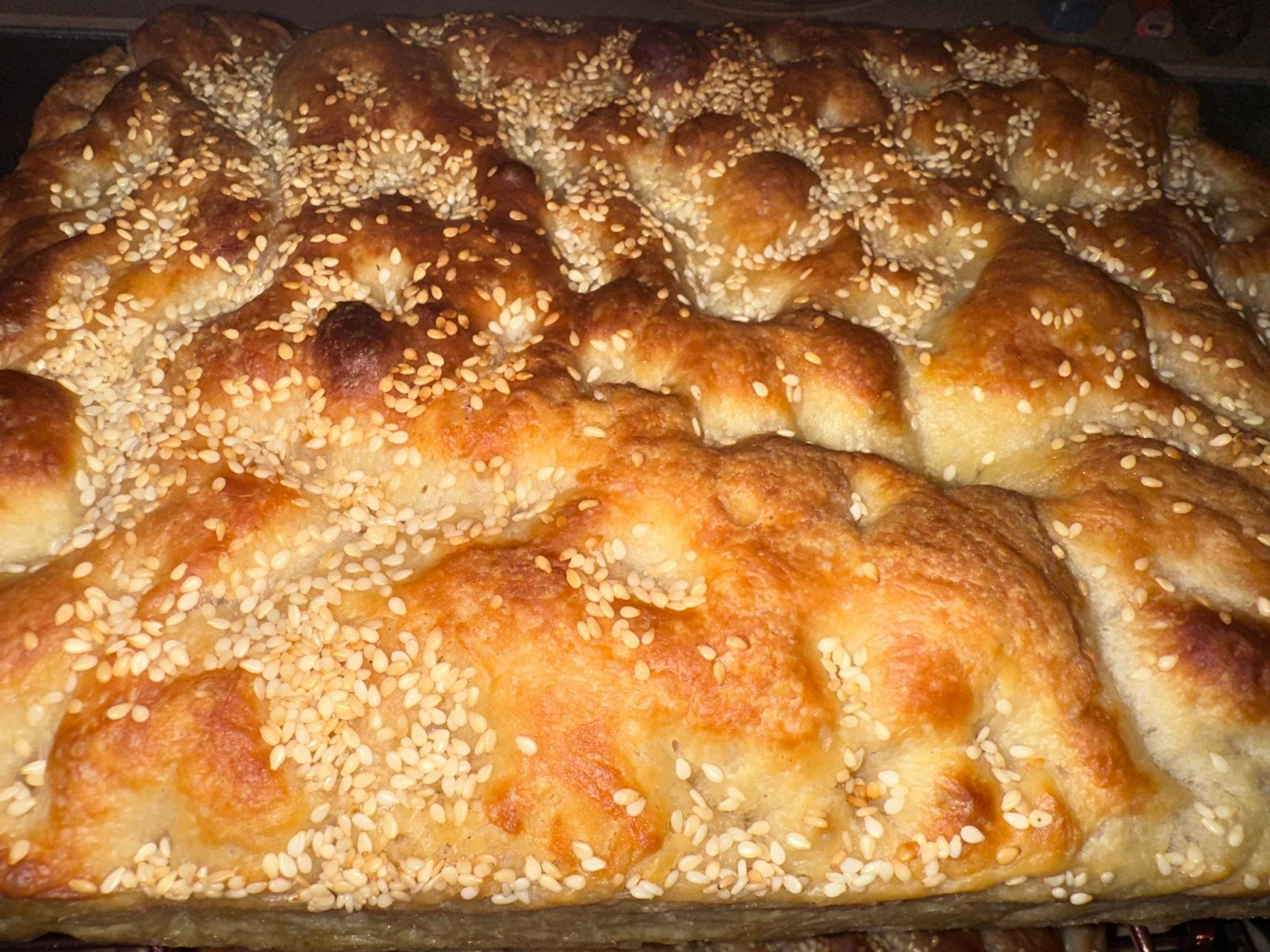
No Knead Sesame Seed Focaccia

600 g and 80 g lukewarm water seperated

5 g active dry yeast

20 g agave

54 g, 40 g and 20 g extra virgin olive oil separated

750 g bread flour

18 g and 5 g kosher salt separated

45 g sesame seeds

Equipment: whisk, wooden spoon, 1 large mixing bowls (enough extra space to allow for rising), 1 medium mixing bowl, 2.5″ deep half hotel pan, parchment paper, probe thermometer, cooling rack

  1. Mix 600 g of water, yeast, agave, and 54 g of olive oil with your whisk in a large mixing bowl. Then in a separate bowl mix the bread flour and 18 g of salt.
  2. Once both bowls are thoroughly mixed, add the dry to the wet and mix until no dry flour remains. Cover and let it proof on the counter for 12-15 hours. If it’s below 70 F in your kitchen, proof it closer to 15 hours.
  3. Once the time has elapsed your dough should have expanded by at least 100%. Add the parchment paper to your pan so that there are 2 sides with a couple inches of paper sticking above the pan.
  4. 40 g of olive oil goes on top of the parchment paper, spread it all across the bottom and up the sides of the pan. Add your proofed dough.
  5. Spread the dough as close to the corners of the pan as it can go without too much effort. Coat the top of the dough with the remaining 20 g of olive oil and let it rest for 15- 20 minutes, or until the dough has relaxed enough so that it can be spread to the edges easily.
  6. Once the dough is spread to each corner, press your fingers into the dough enough times that there isn’t more than 1 square inch or so of dough left untouched.
  7. Evenly pour over the sesame seeds, making sure to get them on the edges as well as the middle. With the remaining 80 g of your water and the 5 grams of salt set aside earlier, make a brine and pour it over the top of the crimped dough.
  8. Let it rest an additional 45 minutes if your kitchen is warm or an hour if your kitchen runs a bit cooler. Preheat your oven to 450 F and move your rack to its lowest position at this point as well.
  9. Once the dough has expanded by 2x and is nice and jiggly, put it in the oven and bake for 25 minutes. Once that time has elapsed, rotate the pan and replace in the oven or another 15 minutes.
  10. At this point, move your oven rack to the highest position possible while still allowing room for the bread. Bake until your probe thermometer reads 210-211 F at the center of the dough.
  11. Remove from the oven and use the extra parchment paper on both sides of the bread to remove it from the pan. If any of the bread exposed to the bare hotel pan sticks, carefully use a spatula to release it from the pan. Once you have the bread out of the pan, place it on a wire rack to cool and dispose the paper after it has cooled enough to handle fully.
  12. Wait until the bread cools completely to slice and serve with your preferred accoutrements or as the base of a sandwich!

Simplicity

I can’t stand when a chef says that the recipe they use for something is “simple” but then use an ultra specific piece of equipment only really available in restaurants or the kitchens of wealthy people that can afford it.

Great, simple recipes are not made so based on the amount of ingredients. The method to get to the other side of raw components

The clip that comes to mind is of a European chef claiming that his “simple dessert” is perfectly delicious, despite his effort. He isn’t lying, because it is simple to him. He takes créme englaise (most likely supplied by one of his lackeys) and adds it to chocolate. Super simple!

The problem is that he dumps this shit into a $2200 Thermomix that can also be used to heat cook the mixture.

Most chefs of a certain level are so sickeningly disconnected from reality that “simplicity” in their presence is only really found after digging through layers and layers of technique and currency. Of course it’s possible to recreate his method and dish in more common home equipment, but the effort and thought required to convert his technique to the real world make the recipe inherently not simple anymore.

It’s hard to say why so many chefs fall into this fallacious habit of over simplifying description and approach, but I would bet money that it’s simply due to them being a bit too disconnected from reality. They’ve been in their realms for so long surrounded by vacuum sealers, Pacojets and Hobarts to realize that the ground that they’re looking down upon is actually just clouds.