How I fed 15ish people

The Occasion: I was hired by a repeat customer to cook for a dinner to feed 15 people. I don’t know if it ended up being that many or more, but the food was a hit and there was plenty of it!

The Menu included bread, 4 dishes for the meal plus dessert and I was told to keep things somewhat light, highlighting the spring season.

Salad: Arugula, Purple leaf lettuce, watercress, mesclun, pickled red onion with a scallion oil and white balsamic vinaigrette and shaved aged cheese.

For the salad option, I like to blend greens for flavor, color and texture. Pickled red onion was actually my dad’s idea, and it ended up being the perfect pop of color dotted throughout the salad. Instead of the slivered pickled onion you normally see, I diced mine and added a small handful of rhubarb to add some depth and help keep the color a deeply rosy pink color. As for the aged cheese, I used grana padana and galmasano, the spanish equivalent to Parmesan, just to keep things a little more interesting yet cost effective.

Bread: My tried and true no-knead focaccia, with a generous layer of chopped spring onions and fresh white pepper cracked over the top just before serving.

I worked on this recipe for years before finally getting it down to an easily repeatable process, and it hasn’t failed me yet! I’ve been using a Spanish blend of Picual and Hojiblanca olive oil from a brand called Zoe and it’s been giving me delicious results.

Main: Spatchcocked Roast Chicken with lemon curd piped under the skin after curing in the fridge for 2 days.

I used scissors to cut out the backbones of 4 large air chilled chickens from a supermarket near me. The choice of air chilled means there is less water surrounding the chicken and thus will season itself a little quicker in the curing process. I used a piping bag once the skin was seasoned and nicely firm to get the salted lemon curd under the skin all the way to the hard-to-reach parts. After roasting, there was nice caramelization across the skin due to the sugar and eggs in the curd. The meat came out perfectly cooked and the skin was nicely caramelized.

Starchy Side: turnips and sweet potatoes roasted in chunks under the chicken with nutritional yeast, salt and white pepper.

I cut the root veg into roughly 1″ chunks and tossed with a little salt and nutritional yeast before placing the chickens on top and roasting.

Veggie Side: Carrots and Edamame on top of Golden Herb yogurt

To help with ease of prep, I took 1 and a half bags of baby carrots and quartered them, along with 2 bags of shelled frozen edamame. I cooked them in butter, nutritional yeast, white balsamic vinegar, a pinch of sugar, a pinch of salt and a pint of richly reduced chicken stock that I made from the backs of the chickens. For the base of golden yogurt I mixed turmeric, umeboshi vinegar, chopped tarragon and dill, salt and nutritional yeast for a deeply flavorful and bright yogurt sauce. Guests were scraping the plate to make sure every bit of it got eaten!

Sauce: Caper Beurre Blanc

I reduced white balsamic, caper juice, chopped shallots and a couple stems of tarragon until the vinegar was nicely thickened and slightly syrupy. For service, I added a half cup or so of heavy cream, a few tablespoons of capers and I mounted in a half stick of butter, adjusting seasoning for taste with salt and white pepper.

Dessert: Cherry Rhubarb Compote with Cornmeal Crumble and Burnt White Chocolate Chantilly

The compote was simple, just chopped rhubarb, a frozen mix of sweet and sour cherries, sugar, agave, salt and white balsamic. I cooked it down until everything was well broken down and tender.

The cornmeal crumble really came out more like a giant soft cornmeal shortbread, which I’m not mad about. Melted butter with Jiffy corn muffin mix, spread across a glass baking dish and baked until golden brown.

For the final component, the cream, I caramelized some white chocolate in a saucepan and then cooled and beat it into some softly whipped cream with crème fraiche until everything was stiff and rich. This whipped cream balanced the whole dessert perfectly with its richness, tanginess and toasted marshmallow-esque bitterness.

All in all, the meal turned out very well. There was plenty of leftover chicken, turnips, sweet potatoes, beurre blanc and focaccia, which is how I like it. Plenty of food for everyone to have enough of. I’m glad I was given the opportunity to cook for a return client.
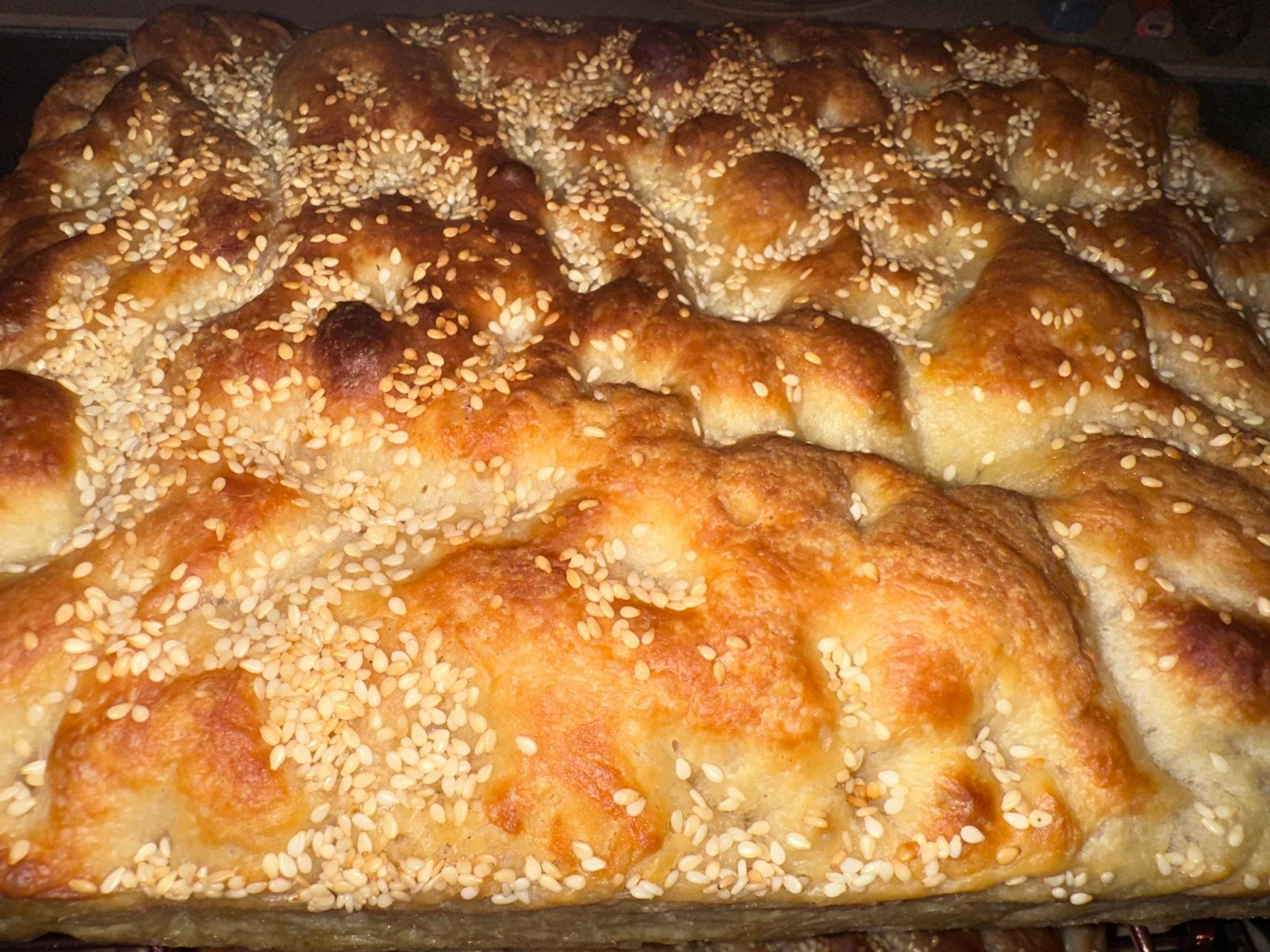
No Knead Sesame Seed Focaccia

600 g and 80 g lukewarm water seperated

5 g active dry yeast

20 g agave

54 g, 40 g and 20 g extra virgin olive oil separated

750 g bread flour

18 g and 5 g kosher salt separated

45 g sesame seeds

Equipment: whisk, wooden spoon, 1 large mixing bowls (enough extra space to allow for rising), 1 medium mixing bowl, 2.5″ deep half hotel pan, parchment paper, probe thermometer, cooling rack

  1. Mix 600 g of water, yeast, agave, and 54 g of olive oil with your whisk in a large mixing bowl. Then in a separate bowl mix the bread flour and 18 g of salt.
  2. Once both bowls are thoroughly mixed, add the dry to the wet and mix until no dry flour remains. Cover and let it proof on the counter for 12-15 hours. If it’s below 70 F in your kitchen, proof it closer to 15 hours.
  3. Once the time has elapsed your dough should have expanded by at least 100%. Add the parchment paper to your pan so that there are 2 sides with a couple inches of paper sticking above the pan.
  4. 40 g of olive oil goes on top of the parchment paper, spread it all across the bottom and up the sides of the pan. Add your proofed dough.
  5. Spread the dough as close to the corners of the pan as it can go without too much effort. Coat the top of the dough with the remaining 20 g of olive oil and let it rest for 15- 20 minutes, or until the dough has relaxed enough so that it can be spread to the edges easily.
  6. Once the dough is spread to each corner, press your fingers into the dough enough times that there isn’t more than 1 square inch or so of dough left untouched.
  7. Evenly pour over the sesame seeds, making sure to get them on the edges as well as the middle. With the remaining 80 g of your water and the 5 grams of salt set aside earlier, make a brine and pour it over the top of the crimped dough.
  8. Let it rest an additional 45 minutes if your kitchen is warm or an hour if your kitchen runs a bit cooler. Preheat your oven to 450 F and move your rack to its lowest position at this point as well.
  9. Once the dough has expanded by 2x and is nice and jiggly, put it in the oven and bake for 25 minutes. Once that time has elapsed, rotate the pan and replace in the oven or another 15 minutes.
  10. At this point, move your oven rack to the highest position possible while still allowing room for the bread. Bake until your probe thermometer reads 210-211 F at the center of the dough.
  11. Remove from the oven and use the extra parchment paper on both sides of the bread to remove it from the pan. If any of the bread exposed to the bare hotel pan sticks, carefully use a spatula to release it from the pan. Once you have the bread out of the pan, place it on a wire rack to cool and dispose the paper after it has cooled enough to handle fully.
  12. Wait until the bread cools completely to slice and serve with your preferred accoutrements or as the base of a sandwich!

The Best Turkey Meatloaf Ever

1.5 lbs ground Turkey

2 slices white bread, crusts removed

1/4 cup heavy cream

1/4 cup milk

1 onion

1/2 of a green bell pepper

1/2 of a red bell pepper

1 tsp neutral cooking oil

1 whole egg

1/2 tbsp garlic powder

1/2 tbsp smoked paprika

1/2 tbsp dried thyme

1/2 tbsp ground ginger

3/4 tbsp salt, plus 1 pinch for sauteing

1/2 tbsp pepper

1/4 cup of ketchup, plus more for serving

1/4 cup grated parmigiano reggiano or grana padana cheese

hot sauce

Equipment: 1 small mixing bowl, 1 medium mixing bowls, cheese grater, chef knife, rimmed sheet pan, saute pan, silicon or wooden spoon

1. Tear the crustless bread into small pieces and soak in a mixture of the cream and milk until its completely mushy (15-20 minutes) in the small mixing bowl.

2. Peel and grate the onion into the medium bowl and preheat your saute pan with the oil over medium heat.

3. Chop the bell peppers into small pieces and add to the hot pan with a pinch of salt and cook until they are softened but not browned. Add to the bowl of grated onion.

4. Drain the excess liquid from the soaked bread and add the bread and the ground turkey to the bowl of grated onion and cooked peppers.

5. Beat the egg with a fork and add to the bowl along with the spices, cheese and ketchup. Mix until fully combined.

6. Form into a loaf shape on a sheet pan and bake at 400F until a meat thermometer inserted into the middle reads 155 F.

7. Let the meatloaf rest for 15 minutes, slice and serve with ketchup, hot sauce and preferred sides.

Simplicity

I can’t stand when a chef says that the recipe they use for something is “simple” but then use an ultra specific piece of equipment only really available in restaurants or the kitchens of wealthy people that can afford it.

Great, simple recipes are not made so based on the amount of ingredients. The method to get to the other side of raw components

The clip that comes to mind is of a European chef claiming that his “simple dessert” is perfectly delicious, despite his effort. He isn’t lying, because it is simple to him. He takes créme englaise (most likely supplied by one of his lackeys) and adds it to chocolate. Super simple!

The problem is that he dumps this shit into a $2200 Thermomix that can also be used to heat cook the mixture.

Most chefs of a certain level are so sickeningly disconnected from reality that “simplicity” in their presence is only really found after digging through layers and layers of technique and currency. Of course it’s possible to recreate his method and dish in more common home equipment, but the effort and thought required to convert his technique to the real world make the recipe inherently not simple anymore.

It’s hard to say why so many chefs fall into this fallacious habit of over simplifying description and approach, but I would bet money that it’s simply due to them being a bit too disconnected from reality. They’ve been in their realms for so long surrounded by vacuum sealers, Pacojets and Hobarts to realize that the ground that they’re looking down upon is actually just clouds.

De-Elitizing High Quality Food

The year is 2024.

Consumers are scrutinizing what they put into their bodies more than ever. Regular, middle class people are actually caring about how they eat, going so far as to label certain ingredients as “toxic” based on advice from non-experts on social media, and further blacklisting a ton of seemingly inconspicuous products because they can’t pronounce a handful of the listed ingredients. These people needlessly fear mongering over “seed oils” and other superfluous buzz words only do so because they can afford to. Meanwhile, the rest of us have become practice dummies for the greedy corporations to crank prices up to see just how much stress they can put on the working class beneath them. The real issue isn’t antibiotics in your chicken, it’s the fact that a lot of people can’t afford anything but the cheapest option in the meat section.

I’m all for caring about this side of processed food, and holding a magnifying glass up against greedy companies pushing “health food” to people desperate for nourishment. More than ever has it become clear that a lot of the mass-produced foodstuff that we see advertised as wholesome and healthy are really just a branding exercise on how deeply misinformed so many of us are about food. In terms of fresh produce, prices are unsettling to say the least. We can tout “eat organic” all day, but when the organic onions are almost 50% more expensive than their non-organic counterpart ($1.69 for non-organic vs. $2.49 for organic), it feels like less of a “rule of thumb” and more like a luxury most available to those who are ahead financially.

I understand the concept of making more money and rightfully being able to provide yourself with a better quality of life. Love it or hate it, that is the reality of the capitalist society we live in. I would be pissed if my raise in pay ended up not showing in how well I can live for myself. However, it should affect things like your brand of sneakers, the size of your TV, or the maker of your car, not the quality of your necessary provisions. After all, from early childhood onward we are told that god himself wants us to have access to “life, liberty and the pursuit of happiness.” Obviously that “life” isn’t guaranteed, the “liberty” has become a shrinking list of shit choices, and the “pursuit of happiness” has been reduced to a desire to achieve what others have, rather than an actual path upward in life.

I’m not saying that everyone needs organic everything all the time. I’m not even saying the organic issue is the most pressing part of our food system here in the USA. What I am saying is that eating healthily shouldn’t be a luxury. Having access to clean, well processed meat and poultry should be expected in the “richest country of the western world,” without exception. Our cultural obsession with always getting bigger and faster and more profitable has officially undermined our ability to properly provide for ourselves, and even when a company comes along to provide that service, it’s typical, sooner or later, for that small business to sell-out to the highest bidder and rid themselves of the headache of operating a business like that as a non-corporation. And the cycle begins again and again. “We want our high quality product on she shelves of every grocery store in America,” is what we hear time and again from local mom-and-pop brands on the come-up. The American Dream was never about creating a better America, it’s been about winning at life. And now it’s not even about that, it’s become more about just getting to the finish line of line with you and yours intact and nothing more. Don’t worry about your neighbors getting screwed, just keep your head down and make it to the end and you’ll be just fine.

I don’t know about you, but I want better for my fellow American no matter how differently they look, think, or vote than me. Better starts at the bottom with strong integrity of individuals, and I fear that we may never return to that type of strength. Yes, an 80¢ difference in onion prices seems insignificant. It’s a minute difference that a lot of people won’t notice, but it is a sign of something that’s wrong with the priorities of our leadership.

Yes, I think everyone at some point in their lives should experience the taste of a perfectly ripe, in-season tomato. Yes I think that sort of experience can convert seasonal produce detractors to agreeing that local, seasonal produce might be good for our communities, even if a little more expensive. But that’s the difference in that sort of thing. Produce like that is a luxury right now for a disturbingly large majority of our populous, not an expectation.

My goal is not necessarily to make the absolute best version of every single dish or idea. My goal is to make the best version of things that can be made just as well for a family who eats produce exclusively from Walmart-Mart or any other large-scale chain grocery store with mediocre produce. I used to easily get caught up on specifics like particular ingredients and brands. I used to get very frustrated when people didn’t take specifics like that as seriously as me. Now I know that technique, intuition, and the ability to adapt are the most important aspects of cooking, and the world would be a better place if everyone had that capacity.

Cornbread Muffins with Berries and Cream

Cornbread Muffins (makes 9 muffins)

130 g ap flour

130 g stone ground yellow cornmeal

8 g baking powder

25 g toasted milk powder

big pinch of salt

2 large eggs

245 g buttermilk

60 g melted butter

80 g honey

1 tbsp butter (for toasting)

Equipment: scale, measuring cups/ spoons (1/3 and 1 cup, 1 tbsp and 1/4 tsp), 2 small mixing bowls, 2 larger mixing bowls, piping bag, 3×3 muffin pan, whisk, serrated knife, small sauté pan

  1. Thoroughly whisk the dry ingredients in a large bowl and the wet in smaller one.
  2. Pour the wet ingredients into the dry and whisk until no pockets of dry ingredients remain, lumps are good so be careful not to overmix. Transfer to a piping bag and rest in the fridge for 30 mins.
  3. Preheat the oven to 400 ℉ and prepare your 3×3 muffin pan by spraying with nonstick spray, or brushing the muffin pan walls with butter.
  4. Fill your muffin molds 3/4 of the way up and bake for 15-18 minutes or until a toothpick poked into the middle comes out with a little bit of moisture and crumbs stuck to it.
  5. Once removed from the oven, flip the muffin pan over on a cooling rack and flip them individually right side up to cool.

Macerated Berries

1 cup Blueberries

1 cup Raspberries

50 g lemon juice

100 g light brown sugar

pinch of salt

  1. In the other small mixing bowl carefully mix the ingredients together every 10 minutes until all the sugar is dissolved into the accumulated juices

Whipped Cream

2/3 cup heavy cream

1/3 cup buttermilk

1 tbsp sugar

1/4 tsp vanilla paste/ extract

1 Pinch of salt

  1. In a larger mixing bowl whip all the ingredients to soft peaks

To Serve

  1. Cut the corn muffins down the middle and toast in a pan with butter
  2. Plate the cut muffins next to each other with a heavy dollop of whipped cream laid across the top and plenty of berries and sauce spooned over the middle and around the edges. Garnish with fresh mint.
  3. Enjoy!

Chick o’ Stick Cookies

Recipe makes 8 cookies

1 cup peanut butter

3/4 cup light brown sugar

1 egg

1 1/4 cups desiccated coconut (separated into 3/4 cup and 1/2 cup)

1/2 cup Turbinado sugar

Equipment: hand mixer, mixing bowl, baking sheet, parchment paper, oven

  1. with a hand mixer cream together the peanut butter, brown sugar and 3/4 cup of the coconut until it’s light and airy
  2. add the egg and blend until smooth
  3. with clean hands, roll the dough into 8 equal sized balls
  4. mix the rest of the coconut and the turbinado sugar together and roll the dough balls in that mixture
  5. bake the cookies 1 inch apart on a parchment lined baking sheet at 350℉ for 10-15 minutes, or when the edges just start to darken

best enjoyed with coffee or tea

Sam’s Coconut Sablé

makes 16 cookies

75 g unsalted butter, room temperature

50 g extra virgin olive oil

80 g white sugar

25 g fine dry coconut

55 g egg yolk

5 g dark rum (optional)

3 g salt

5 g baking powder

50 g powdered coconut milk

130 g all-purpose flour

  1. Mix the butter, olive oil, sugar and dry coconut until the mixture is fully incorporated and slightly fluffy.
  2. Add the egg yolk, rum and salt and mix thoroughly.
  3. Add the rest of the ingredients and mix until no dry bits of flour remain. Chill the dough for at least 1 hour.
  4. Once fully chilled, preheat the oven to 300℉. Roll the dough into 16 balls, each one approximately weighing 30 grams. You should end up with 16 dough balls.
  5. Space the dough balls out on 2 parchment lined baking sheets and bake for 10-12 minutes. The edges of the sable should be just barely starting to brown.
  6. Cool for 5 minutes on the sheet trays, then remove the cookies from their trays and finish cooling on the counter until they’re no longer warm to the touch.

Vanilla: Basic or Bullied?

What do you think of when you hear the word “vanilla?” Does it conjure up images of plainness, boredom or familiarity? For years, vanilla simply served as a basic flavor for me, as it does for most people. As for vanilla sweets, I never preferred them, but they were always there just in case someone happened to not like chocolate. I didn’t dislike it, nor did I ever seek it out in any capacity. As I’ve gotten older, I’ve learned that having the same thing over and over gets old, even when it comes to the things we enjoy the most. I learned to cherish the intention that some things should be enjoyed with, those being indulgent things like gelato and cheesecake that could ruin my health if I had it every day. Every day does not need to include the most decadent dishes; Sometimes something light and simple makes you feel the best.

Recently I started trying to look at vanilla as a balancer of flavor, a baseline to build upon, as well as its own pillar. I would argue that most don’t know the taste of vanilla in its purest form: floral, pungent and almost spiced. This I blame on the quality of most vanilla syrup and extract, those being the most common forms of vanilla that most people encounter in their everyday lives. For example, vanilla and coffee compliment each other wonderfully, but a bad quality vanilla quite literally sabotages your whole experience.

I see that most people don’t even think twice when it comes to stuff like that. “The quality of this vanilla is not good enough” surely isn’t a thought that a lot of people have. I am not those people. If I’m looking forward to something nice and vanilla flavored, I’m not looking for some half assed vanilla something or other, I expect it to hold its own. That’s why I don’t get vanilla coffee. Most places use mid vanilla syrup, and I would rather not even fool with it in most cases. With food costs reaching record highs, it has become more important than ever for me to be pickier when it comes to paying money for food products/ ingredients. Some would consider that being too bougee, stuck up or even snobbish. I want my food to work for me, just like I worked for the means to be able to afford things in that higher quality bracket of products.

So next time you get vanilla ice cream, vanilla coffee or anything that can be seen as boring because of its vanilla characterization, think about the fact that vanilla is wonderful! We have to hold the things that we consume at a higher standard. Believe me, I know how hard it is to not be able to afford all the nicest versions of things, but cherish the times you DO have the opportunity to pick that real vanilla extract, paste or beans. Your taste buds will thank you, along with all the people in your life that you get the pleasure of sharing your creations with.

White cheddar biscuits with Calabrian chili butter

2 cups/ 300 g all-purpose flour

1 tbsp/ 14 g sugar

2 tsp/ 12 g kosher salt

2 1/2 tsp/ 8 g baking powder

1/2 tsp/ 4 g baking soda

1/2 cup/ 15 g very cold unsalted butter, grated

1 cup/ 80 g shredded aged white cheddar (look for labels that describe it as tasting similar to parmesan)

1 stick softened, unsalted butter

1 large head of roasted garlic (about 8 decent sized cloves)

2 tsp chopped Calabrian chilis (use 1 tsp if you don’t want it as spicy)

zest of 1 grapefruit (or 2 lemons)

a 4-finger pinch of flaky salt

  1. Combine all of the dry ingredients with the butter and cheese and mix thoroughly. Stir in 1 cup of cold buttermilk and mix until no dry spots remain.
  2. Wrap the dough in plastic and rest in the fridge for 30 minutes. After this time, lightly flour your clean countertop and roll out the dough until it is 1/2 inch thick. Fold like a triple-folded pamphlet and roll out again the same way, folding the same way at the end. Try to keep the edges as squared away as possible.
  3. Cover and rest the dough for 15 minutes. Then cut into 8 even squares/ rectangles. Place on a sheet tray with a finger width of space between each one.
  4. Brush with the egg wash and bake at 400℉ for 10- 15 minutes, or until golden brown on top and bottom.
  5. Make your compound butter. Wrap in plastic to chill. Once solid, cut into square pieces to place inside of your warm, sliced biscuits.