How I fed 15ish people

The Occasion: I was hired by a repeat customer to cook for a dinner to feed 15 people. I don’t know if it ended up being that many or more, but the food was a hit and there was plenty of it!

The Menu included bread, 4 dishes for the meal plus dessert and I was told to keep things somewhat light, highlighting the spring season.

Salad: Arugula, Purple leaf lettuce, watercress, mesclun, pickled red onion with a scallion oil and white balsamic vinaigrette and shaved aged cheese.

For the salad option, I like to blend greens for flavor, color and texture. Pickled red onion was actually my dad’s idea, and it ended up being the perfect pop of color dotted throughout the salad. Instead of the slivered pickled onion you normally see, I diced mine and added a small handful of rhubarb to add some depth and help keep the color a deeply rosy pink color. As for the aged cheese, I used grana padana and galmasano, the spanish equivalent to Parmesan, just to keep things a little more interesting yet cost effective.

Bread: My tried and true no-knead focaccia, with a generous layer of chopped spring onions and fresh white pepper cracked over the top just before serving.

I worked on this recipe for years before finally getting it down to an easily repeatable process, and it hasn’t failed me yet! I’ve been using a Spanish blend of Picual and Hojiblanca olive oil from a brand called Zoe and it’s been giving me delicious results.

Main: Spatchcocked Roast Chicken with lemon curd piped under the skin after curing in the fridge for 2 days.

I used scissors to cut out the backbones of 4 large air chilled chickens from a supermarket near me. The choice of air chilled means there is less water surrounding the chicken and thus will season itself a little quicker in the curing process. I used a piping bag once the skin was seasoned and nicely firm to get the salted lemon curd under the skin all the way to the hard-to-reach parts. After roasting, there was nice caramelization across the skin due to the sugar and eggs in the curd. The meat came out perfectly cooked and the skin was nicely caramelized.

Starchy Side: turnips and sweet potatoes roasted in chunks under the chicken with nutritional yeast, salt and white pepper.

I cut the root veg into roughly 1″ chunks and tossed with a little salt and nutritional yeast before placing the chickens on top and roasting.

Veggie Side: Carrots and Edamame on top of Golden Herb yogurt

To help with ease of prep, I took 1 and a half bags of baby carrots and quartered them, along with 2 bags of shelled frozen edamame. I cooked them in butter, nutritional yeast, white balsamic vinegar, a pinch of sugar, a pinch of salt and a pint of richly reduced chicken stock that I made from the backs of the chickens. For the base of golden yogurt I mixed turmeric, umeboshi vinegar, chopped tarragon and dill, salt and nutritional yeast for a deeply flavorful and bright yogurt sauce. Guests were scraping the plate to make sure every bit of it got eaten!

Sauce: Caper Beurre Blanc

I reduced white balsamic, caper juice, chopped shallots and a couple stems of tarragon until the vinegar was nicely thickened and slightly syrupy. For service, I added a half cup or so of heavy cream, a few tablespoons of capers and I mounted in a half stick of butter, adjusting seasoning for taste with salt and white pepper.

Dessert: Cherry Rhubarb Compote with Cornmeal Crumble and Burnt White Chocolate Chantilly

The compote was simple, just chopped rhubarb, a frozen mix of sweet and sour cherries, sugar, agave, salt and white balsamic. I cooked it down until everything was well broken down and tender.

The cornmeal crumble really came out more like a giant soft cornmeal shortbread, which I’m not mad about. Melted butter with Jiffy corn muffin mix, spread across a glass baking dish and baked until golden brown.

For the final component, the cream, I caramelized some white chocolate in a saucepan and then cooled and beat it into some softly whipped cream with crème fraiche until everything was stiff and rich. This whipped cream balanced the whole dessert perfectly with its richness, tanginess and toasted marshmallow-esque bitterness.

All in all, the meal turned out very well. There was plenty of leftover chicken, turnips, sweet potatoes, beurre blanc and focaccia, which is how I like it. Plenty of food for everyone to have enough of. I’m glad I was given the opportunity to cook for a return client.
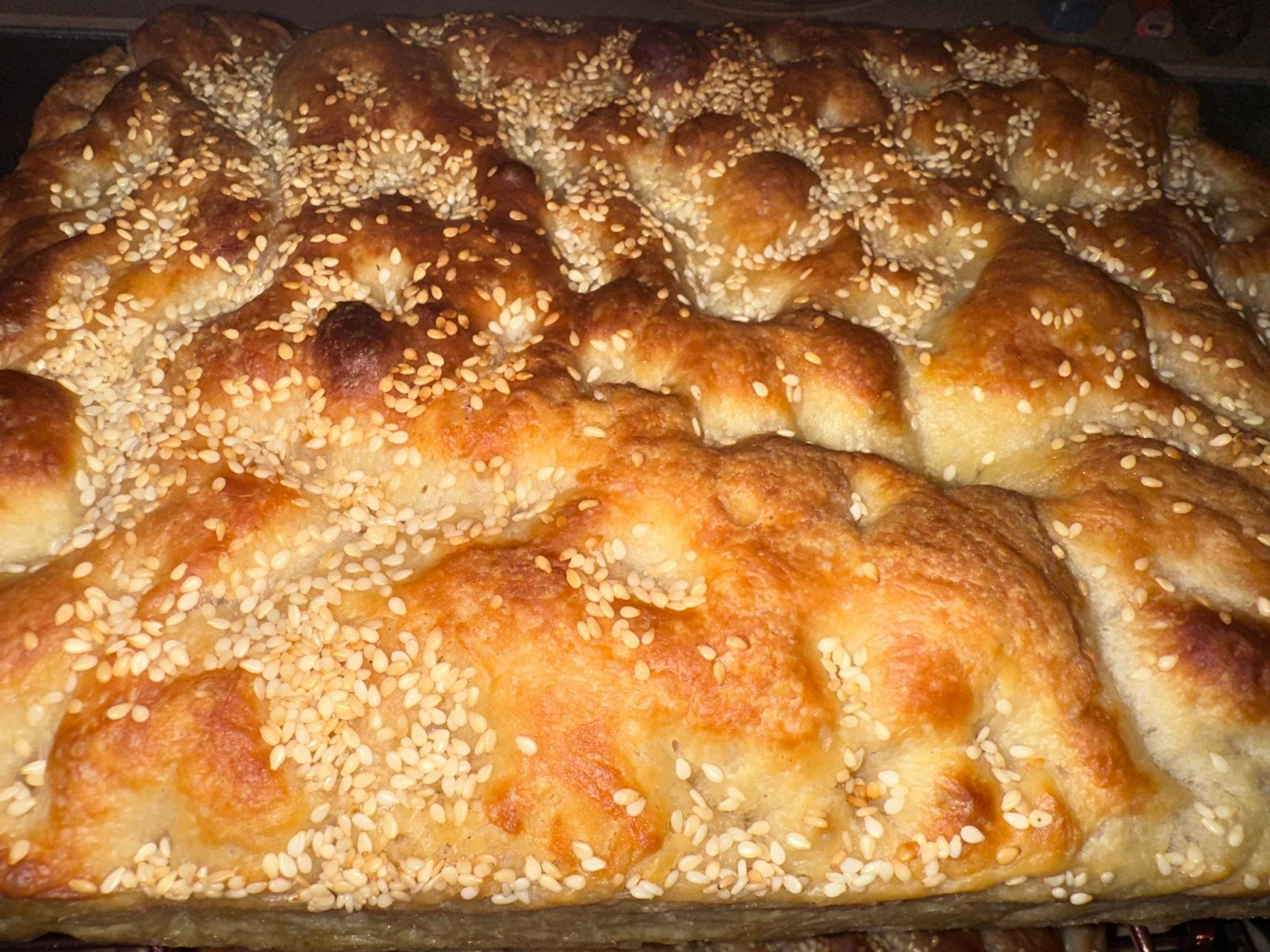
No Knead Sesame Seed Focaccia

600 g and 80 g lukewarm water seperated

5 g active dry yeast

20 g agave

54 g, 40 g and 20 g extra virgin olive oil separated

750 g bread flour

18 g and 5 g kosher salt separated

45 g sesame seeds

Equipment: whisk, wooden spoon, 1 large mixing bowls (enough extra space to allow for rising), 1 medium mixing bowl, 2.5″ deep half hotel pan, parchment paper, probe thermometer, cooling rack

  1. Mix 600 g of water, yeast, agave, and 54 g of olive oil with your whisk in a large mixing bowl. Then in a separate bowl mix the bread flour and 18 g of salt.
  2. Once both bowls are thoroughly mixed, add the dry to the wet and mix until no dry flour remains. Cover and let it proof on the counter for 12-15 hours. If it’s below 70 F in your kitchen, proof it closer to 15 hours.
  3. Once the time has elapsed your dough should have expanded by at least 100%. Add the parchment paper to your pan so that there are 2 sides with a couple inches of paper sticking above the pan.
  4. 40 g of olive oil goes on top of the parchment paper, spread it all across the bottom and up the sides of the pan. Add your proofed dough.
  5. Spread the dough as close to the corners of the pan as it can go without too much effort. Coat the top of the dough with the remaining 20 g of olive oil and let it rest for 15- 20 minutes, or until the dough has relaxed enough so that it can be spread to the edges easily.
  6. Once the dough is spread to each corner, press your fingers into the dough enough times that there isn’t more than 1 square inch or so of dough left untouched.
  7. Evenly pour over the sesame seeds, making sure to get them on the edges as well as the middle. With the remaining 80 g of your water and the 5 grams of salt set aside earlier, make a brine and pour it over the top of the crimped dough.
  8. Let it rest an additional 45 minutes if your kitchen is warm or an hour if your kitchen runs a bit cooler. Preheat your oven to 450 F and move your rack to its lowest position at this point as well.
  9. Once the dough has expanded by 2x and is nice and jiggly, put it in the oven and bake for 25 minutes. Once that time has elapsed, rotate the pan and replace in the oven or another 15 minutes.
  10. At this point, move your oven rack to the highest position possible while still allowing room for the bread. Bake until your probe thermometer reads 210-211 F at the center of the dough.
  11. Remove from the oven and use the extra parchment paper on both sides of the bread to remove it from the pan. If any of the bread exposed to the bare hotel pan sticks, carefully use a spatula to release it from the pan. Once you have the bread out of the pan, place it on a wire rack to cool and dispose the paper after it has cooled enough to handle fully.
  12. Wait until the bread cools completely to slice and serve with your preferred accoutrements or as the base of a sandwich!

Multipurpose Dough (double batch)

300g warm milk

200 g warm water

9g/ 2 tsp active dry yeast

88 g/ 7 tbsp sugar

18 g/ 3 tsp salt

100 g/ 7 tbsp fat (olive oil or clarified butter for the best taste)

904 g/ 2 lbs/ 7 cups flour (bread pref, ap works well enough)

1-2 Tbs olive oil (for oiling the bowl)

Stand Mixer

Countertop for shaping

  1. Add the ingredients in the order that they appear above to the bowl of a stand mixer with the dough hook attached. Mix on low speed until all the flour is incorporated with the liquid; be sure to scrape the bottom of the bowl just to be sure there isn’t any dry pockets.
  2. Detach the dough hook and leave It in the bowl with the dough. Let the dough rest for 2 hours covered in plastic or a damp, clean linen tea towel.
  3. Replace the bowl on the mixer and reattach the dough hook. Mix on low/ medium speed until the dough looks much tighter and smoother than it started.
  4. Rest the dough for 20 minutes and repeat step 3.
  5. Once the dough is very smooth and stretchy, place the dough on the counter and flatten it out. Grab and pull each side to the middle of the dough, firmly attaching these arms to itself. Flip the dough over and roll the dough in circles against the counter until you have a perfectly smooth ball of dough. Oil the bowl up and add the dough back, seam side down, and make sure oil has coated the dough. Ferment covered on the counter until doubled in size.
  6. From this point, I like to cut the dough in half and freeze one of the halves to use later. You can use this dough for a loaf of white bread, pigs in a blanket, pizza pockets, or anything that you can think to use dough for!